
Back to first post in the series: Check for blind spots: a roadmap to parking’s transformation
Online reviews disrupted retail and services, streaming reshaped entertainment, and now parking is having its “Uber moment.”
In keeping with the nature of disruption, parking isn’t inching toward change but racing toward it, propelled by six powerful forces collectively tipping it into its digital future:
- Commerce has gone fully digital.
- Consumers value experiences more than things and their spending follows.
- Channels are consolidating around dominant platforms and marketplaces.
- Cars are becoming connected, electric, and increasingly autonomous.
- Computing is being rewired by artificial intelligence.
- Cities are rethinking parking amidst major shifts in mobility patterns.
Each trend is powerful on its own. Converging inside a fragmented industry with 50,000+ asset owners, thousands of operators, and a maze of point solutions, they produce a dramatic inflection point with driver expectations reshaping the parking experience from the ground up.
What follows is more observation than forecast but nevertheless reveals a blueprint for how parking is evolving from overlooked infrastructure to a strategic asset.
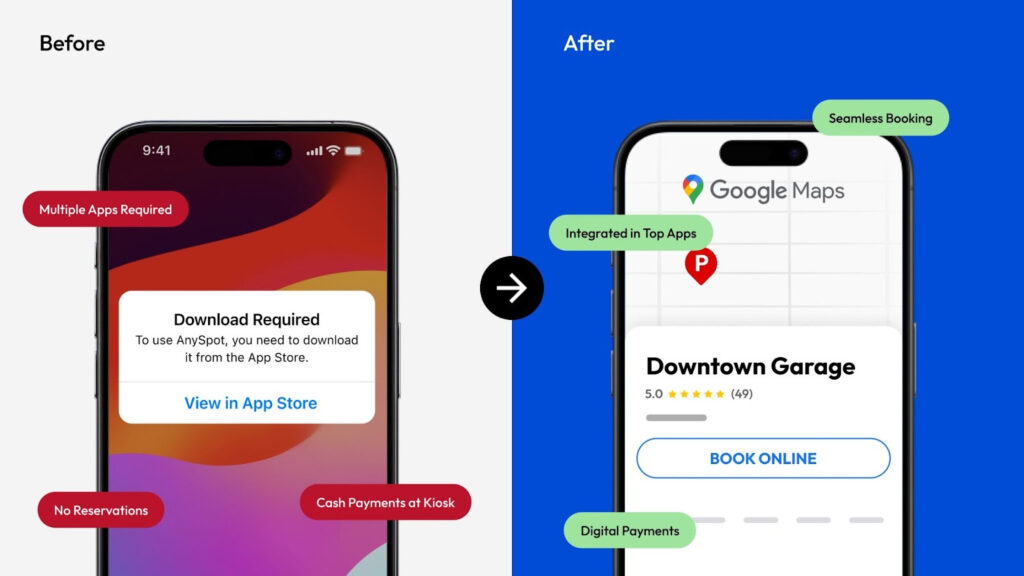
Gone are the days of circling blocks and parking kiosks as consumers embrace premium, digital experiences. Their changing expectations paint a clear path forward for next-generation parking – they want to find, park and pay digitally and seamlessly using the apps they already know and trust.
1. Commerce: Digital Dominance
The broader economy has already made the leap to digital commerce.
Nearly everyone has a mobile phone. Nearly everyone has made a digital payment in the past year, and the majority (65%) of American adults use digital wallets on a monthly basis. With growing comfort buying anything from groceries to luxury goods without ever taking out a physical card, phones are all but replacing wallets, and digital payments are becoming the default.
It’s a reality that extends beyond retail, restaurant reservations and rideshare. In the commercial property sector, digital amenities and frictionless experiences are now top of mind for most tenants who consider them “very important” in property selection.
Parking has partially followed. The industry has done the hard work of upgrading pay stations, adding QR codes, and experimenting with mobile payment apps. Those that have are already capitalizing – Denver International Airport’s move to cashless kiosks has dropped complaints 30-40 percent and freed up staff to focus on customer service.
And while digitizing payment is an important first step, it only solves for how a customer pays – not where, when, and why they choose a parking facility in the first place. Full digital integration – surfacing in a mobile search, offering online reservations and checkout, appearing in a mobility app – all shape parking selections long before drivers approach the gate.
2. Consumers: The Experience Economy
Spending on experiences has outpaced spending on goods over the past decade. It’s a fundamental driver in consumer expectations across demographics that colors how people feel about everything surrounding the experiences they buy – from the moment of departure to the moment they return. Parking sits squarely in that window.
Through the lens of today’s consumer expectations, parking is a defining step within a customer journey. As the first and last touchpoint, it has the potential to differentiate the journey and the revenue it produces for good or for bad.
Too often, parking is a painful or stressful step in the journey that entails circling blocks, guessing availability, and discovering too late a garage doesn’t offer EV charging or doesn’t support a preferred way to pay.
Savvy providers treat parking as part of the experience, not a separate chore, and offer a digital, guided approach – pre-booked spaces, directions sent to a specific facility, a guaranteed charger on arrival. Conversely, parking managed as a disconnected utility is quickly falling behind on technology and actively eroding the experiences of customers and tenants.
For those that adopt the experience mindset, the revenue rewards are real. Consumers will pay up to 16 percent more for great experiences, and the loyalty payoff can be even bigger – our data show eventgoers spend 140% more after a positive experience over a negative one.
3. Channels: App Anxiety
The rise of digital transactions and mobile everything casts a shadow – consumer anxiety and fatigue has set in as the number of mobile apps surpasses a combined four million for Android and iOS. The average smartphone has 80 mobile apps, and consumers interact with nine daily and only 30 in a given month.
While consumers enjoy the convenience and benefits apps offer, they prefer those they already know and trust. In response, the market has consolidated around powerful platforms and “super-app” experiences, which are projected to triple in the U.S. by 2030. Navigation, ticketing, messaging, mobility, and commerce apps now embed a wide range of services: bike rentals, food delivery, hotel booking, payments, and more.
For parking, the takeaway is clear – parking must live where attention already is. Drivers expect to be able to plan and pay for parking inside the apps they already trust – maps, event apps, tenant experience apps, calendar tools, even the vehicle’s own interface.
This has profound implications for how parking is marketed and monetized. The winning strategy is not getting your customers to download your app but plugging your inventory into the platforms that drive demand. Interoperable systems and open APIs will win over walled gardens. The providers that move first to integrate parking in major navigation and ticketing platforms – Google Search, Google Maps, Waze, Ticketmaster, AXS, SeatGeek and Vivid Seats – will reap the rewards.
As we redefine cars and computers, so must we redefine parking to provide equally frictionless experiences to drivers in vehicles and driverless vehicles alike and to offer amenities and spaces for needs that span EV charging, fleet staging and ongoing, occasional or event parking.
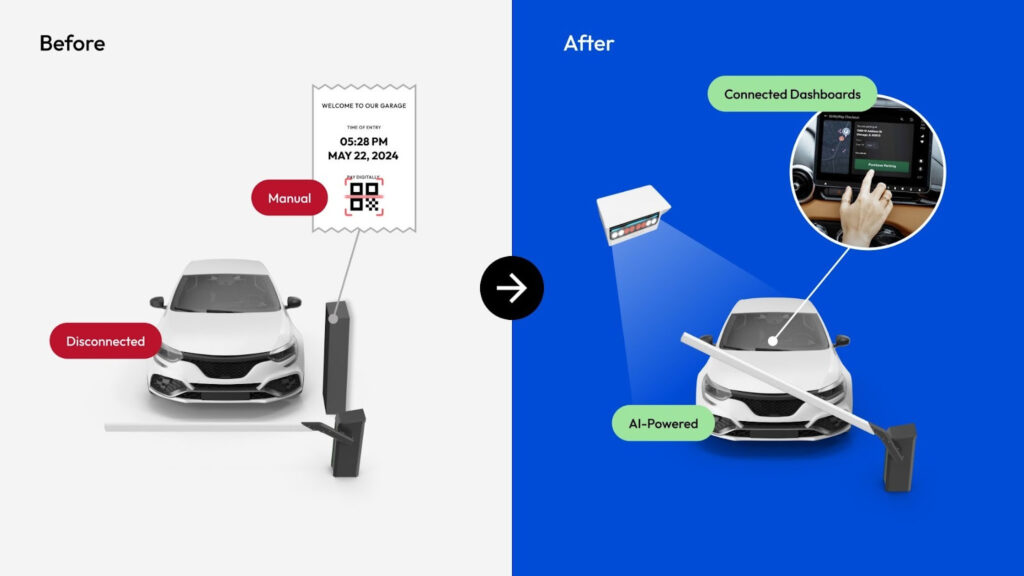
As we redefine cars and computers, so must we redefine parking to provide equally frictionless experiences to drivers in vehicles and driverless vehicles alike and to offer amenities and spaces for needs that span EV charging, fleet staging and ongoing, occasional or event parking.
4. Cars: Electric, Connected and Autonomous
The vehicle itself has become a digital endpoint.
Connected car shipments – expected to exceed 180 million in the U.S. by 2028 – are rolling out with embedded navigation, commerce capabilities, and app ecosystems that reflect heavy automaker investments for in-vehicle payments and services. At the same time, electric vehicles (even with market cooling) are moving mainstream at a pace reaching 11% of U.S. auto sales in September 2025, self-driving features are maturing, and fully autonomous vehicle (AV) pilots are expanding.
It’s a fundamental shift in how cars are engineered that transforms parking from purely physical infrastructure – a place to store a vehicle – into digital infrastructure that offers a place to refuel, transact, and connect. AVs introduce another layer of complexity since they cannot take a paper ticket, speak with an attendant, or manually operate a kiosk.
For EV drivers, the question is no longer “Is there a space?” It is “Is there a working charger, and will it be available when I arrive?” AVs must be able to interact with infrastructure digitally – identifying the facility, establishing permissions, handling payment, and entering or exiting without human assistance. And fleets must be able to do both at scale. All are willing to pay a premium for parking facilities that support their requirements.
The disconnect between legacy processes and the needs of connected, electric, and autonomous vehicles will only grow. Facilities that do not offer digital interfaces, interoperable access, and EV/AV compatible thinking will simply drop out of consideration.
5. Computing: The AI Acceleration
AI is no longer emerging, it’s accelerating, and in parking, its impact is concrete.
Computer vision, machine learning, and real-time analytics are reshaping how demand is captured, how inventory is managed, and how revenue is optimized. Cameras can now recognize vehicles with extraordinary accuracy. Algorithms can detect anomalies and patterns across thousands of daily transactions. Pricing engines can model the impact of an event, a storm, or a shift in commute patterns and adjust in real time.
For drivers, AI compresses complexity into a simple outcome: “Here are the best parking options for you right now.” Instead of confronting an overwhelming list of facilities within a mile radius, they receive a curated set of choices that reflect their preferences for cost, convenience, EV charging, or walking distance.
For owners and operators, AI fundamentally changes the economics of parking. A smaller, well-equipped garage that continuously optimizes occupancy and pricing can outperform a larger, underutilized facility that is blind to actual demand signals.
The AI acceleration calls for new strategies and models for parking: as AI increasingly powers discovery and recommendation in maps, mobility apps, and vehicles, inventory that is not digitally visible is effectively invisible. Assets that are not present in those systems are not just hard to find – they may as well not exist. While the principles of running a parking business remain, AI amplifies their impact and penalizes their absence.
Renewed focus on how we move through and around cities and optimize the use of limited real estate is changing parking’s profile from underutilized asset to critical mobility infrastructure that can dynamically adjust to shifting demands and commute patterns in real time.
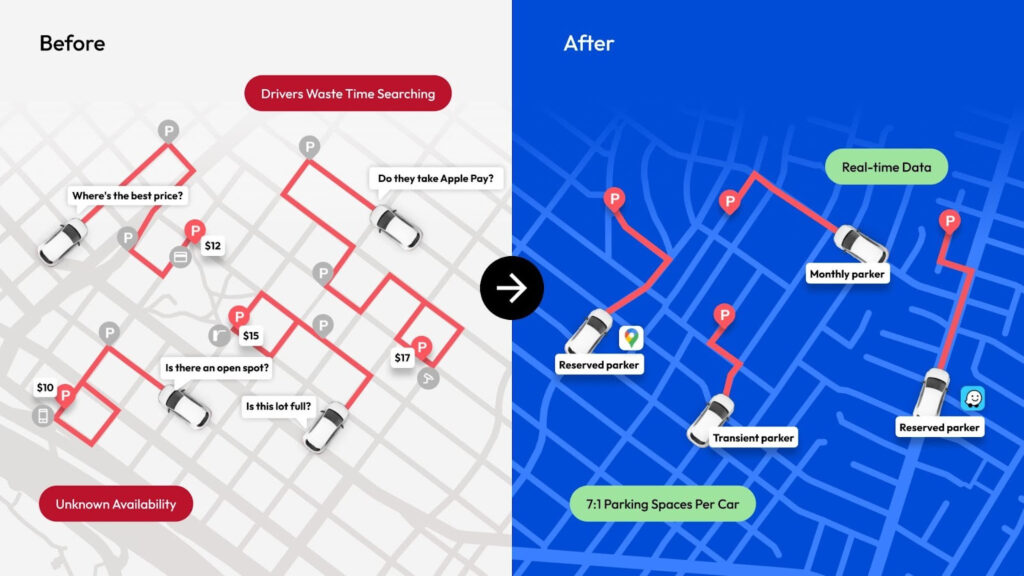
Renewed focus on how we move through and around cities and optimize the use of limited real estate is changing parking’s profile from underutilized asset to critical mobility infrastructure that can dynamically adjust to shifting demands and commute patterns in real time.
6. Cities: Urban Mobility Transformation
The way people move through and around cities is always dynamic but perhaps never more so than over the past 5 years. Cities, employers, and property owners had to adjust, and quickly. Hybrid and remote work, changing commutes, renewed focus on affordability and livability, “smart cities,” and robotaxis are all at play in shaping how people move through urban environments now.
Local governments are investing in data, automation, and dynamic management of infrastructure. They are reclaiming curb space for bike lanes, loading zones, delivery hubs, and outdoor use. And they are tightening on-street parking and eliminating parking minimums for developers and property owners.
At the same time, drivers in many urban areas still average 17 hours each year searching for parking, burning fuel and patience. Supply is not the problem – estimates show 7 spaces for every car on the road – but coordination is. Space often exists, but drivers either can’t see or secure it when they need it.
And as robotaxi pilots give way to autonomous fleets, cities can expect more vehicles to hit the busiest streets. Smart parking is critical infrastructure in this new urban mobility fabric. Digitally enabled parking facilities can:
- Signal real-time availability to city systems and mobility apps
- Support programs that blend transit, micro-mobility, and parking into coherent “door-to-door” offerings
- Enable employers to manage hybrid commuting through flexible access and pricing
- Provide a critical off-street staging area for autonomous fleets between trips
Cities that move toward dynamic, tech-enabled mobility will move away from analog, opaque parking inventory that increases congestion and undermines policy goals. They will increasingly favor assets that can plug into data-sharing frameworks, digital permitting, and coordinated demand programs.
Forward-thinking providers who understand the full potential of parking facilities in the civic operating system – not just as a private real estate asset – will be positioned to partner with cities and influencers as the next generation of cities emerge.
The Tipping Point
Fully digital commerce, experience-driven consumers, platform-centric channels, connected and electric vehicles, AI-native operations, and smart city initiatives are not speculative trends. They are here now. Individually, any one of these would justify rethinking parking. Combined, they make the status quo untenable.
The industry is standing at a tipping point where parking can finally step into its rightful role as critical, connected infrastructure in the modern mobility and real estate stack. The assets that make that leap will see more demand, more yield, and more strategic relevance. Those that don’t will struggle with declining share, underutilization, and increasing pressure from tenants, cities, and drivers who simply expect more.
In the next installment of this series, we’ll shift from macro forces to ownership. The story will move inside the buildings, campuses, and mixed-use environments where parking has long been treated as an afterthought on the balance sheet – and explore why those who control the underlying real estate are uniquely positioned to lead the transformation this moment demands.